
Taekwondo Belts Colors and Ranks (All Explained)
The taekwondo belts system was introduced in 1940, a fundamental part of tradition and training. While the black belt is often seen as the ultimate goal, the journey through various colored belts shows dedication, skill, and discipline which is equally important for every student. Each belt color marks a specific stage of learning and development.
Taekwondo, organized by the International Taekwon-Do Federation (ITF) and World Taekwondo (WT). They use a structured colored belt system to denote geup(degree) rank, with slight variations in belt colors. The ITF has white, yellow, green, blue, red, and black belts, while WT includes orange and purple.
Advancing through ranks in taekwondo includes rigorous tests in forms (poomsae), sparring (gyorugi), and breaking (kyukpa), alongside learning its history and ethics. Each belt earned signifies progress in technique, strength, and understanding, preparing students for higher challenges and responsibilities.
International Taekwondo Federation (ITF) Belts Order
The ITF Taekwondo ranking system ranges from the 10th Gup (beginner, white belt) to the 1st Dan(advanced color belt, black belt), and then progresses through 1st dan (1st-degree black belt) up to 9th dan (10th-degree black belt), which is the highest attainable rank. Explore all Taekwondo black belt degrees at: https://beltsintaekwondo.com/taekwondo-black-belts/
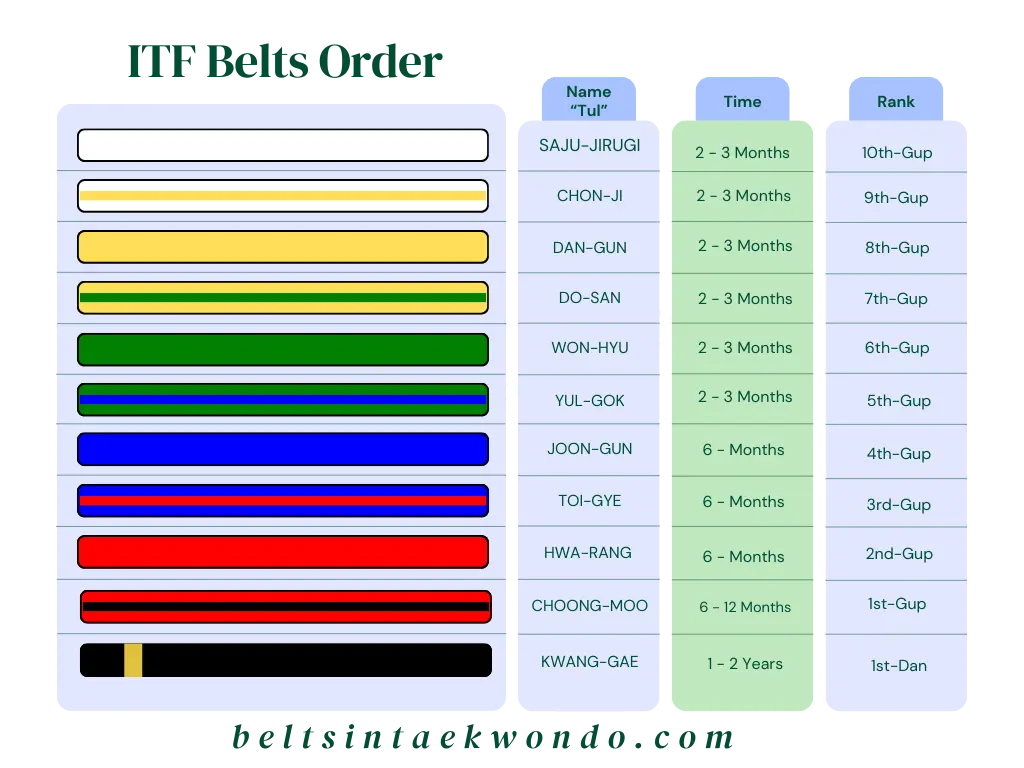
The table below shows the ITF taekwondo belt ranks, forms, and patterns.
|
Geup(Degree) |
Level |
Belt Color |
Movements |
Time to Advance |
|---|---|---|---|---|
|
10th-Geup |
Beginner |
White Belt |
Only Basic Exercises |
2 – 3 – Months |
|
9th-Geup |
Beginner |
White Belt + Yellow stripe |
19 Moves |
2 – 3 – Months |
|
8th-Geup |
Beginner |
Yellow Belt |
21 Moves |
2 – 3 – Months |
|
7th-Geup |
Beginner |
Yellow Belt + Green stripe |
24 Moves |
2 – 3 – Months |
|
6th-Geup |
Intermediate |
Green Belt |
28 Moves |
2 – 3 – Months |
|
5th-Geup |
Intermediate |
Green Belt + Blue stripe |
38 Moves |
2 – 3 – Months |
|
4th-Geup |
Intermediate |
Blue Belt |
32 Moves |
6 – Months |
|
3rd-Geup |
Advanced |
Blue Belt + Red stripe |
37 Moves |
6 – Months |
|
2nd-Geup |
Advanced |
Red Belt |
29 Moves |
6 – Months |
|
1st-Geup |
Advanced |
Red Belt + Black Stripe |
30 Moves |
6 – 12 – Months |
|
1st-Dan |
Black Belt Beginner |
Black Belt |
39 Moves |
1- 2 – Years |
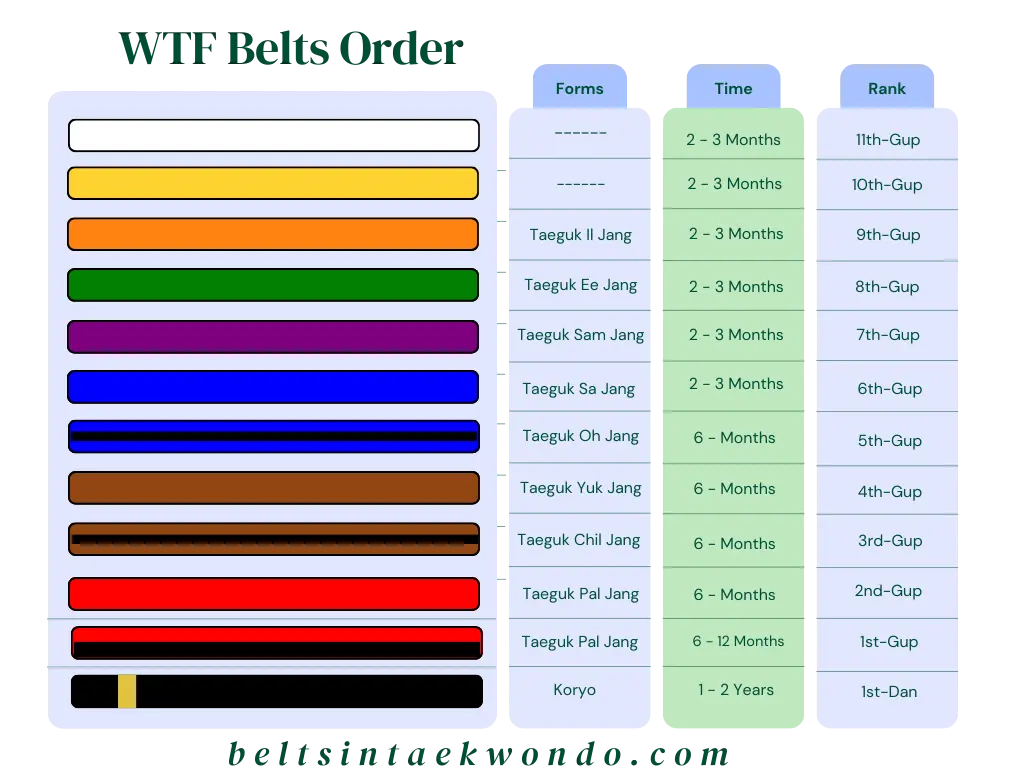
World Taekwondo (WTF) Belts Order
WTF Taekwondo has a slight difference, as seen in the ITF system. In WTF they use solid unique colors instead of striped belts. The table below clearly shows the WTF taekwondo belt ranks.
Taekwondo Belts Color and Meanings
Taekwondo belts have great significance in meanings, each represents a student’s learning level of knowledge, discipline, and skill. Each color reflects stages of progression and growth within the ranks.
As students advance, they master new techniques, cultivate discipline, and gain a deeper understanding of Taekwondo’s principles. The belts serve as visible symbols of their dedication, perseverance, and commitment to their training. Each advancement is a testament to their hard work and journey through the art of Taekwondo.
Taekwondo – White Belt
Meaning: Innocence and a new beginning
The White belt is the initial stage of training in all schools of Taekwondo, representing beginners embarking on their journey. It symbolizes purity and a fresh start, the student has no prior knowledge in this state. In this level, students learn Keebon One form and essential techniques like Front kick, Roundhouse kick, Side Kick, Front stance, middle punch, and Low Block.

Taekwondo – Yellow Belt
Meaning: Foundation and the beginning of the journey
The Yellow belt in Taekwondo marks a significant step forward, representing progress and growth beyond the novice White belt level. Symbolically, the yellow color of the belt compares to a seed being planted, symbolizing the budding foundation of Taekwondo skills for the student. In this beginning level students learn the Back Kick and Front Stance.

Taekwondo – Orange Belt
Meaning: Preliminary foundation
Once students complete the Yellow Belt requirements, they advance to the Orange Belt in Taekwondo with growth and new abilities. This color represents the sunrise, announcing the emergence of new developments and abilities. This stage introduces new techniques such as the Trap Back Kick, High Punch, Middle Block, and High Block. Orange Belt is the final rank in the beginner program.

Taekwondo – Green Belt
Meaning: Growth and development
The Green Belt in Taekwondo is the beginning of the intermediate stage. It is signed as the ongoing progress and the learning of new techniques within the discipline. It marks a crucial stage for Axe Kick for breaking and sparring and Back Stance techniques. It reflects the practitioner’s dedication to continuous learning and improving foundational skills.

Taekwondo – Purple Belt
Meaning: Intermediate growth
At Purple Belt in Taekwondo, students refine their skills and focus on mastering the 360º Kick, facing one of the more challenging stages on the path to the black belt. This step represents the Earth’s strength, like the majestic mountains and tall trees. To conquer this great challenging resemblance, students achieve it through consistent and continuous training.

Taekwondo – Blue Belt
Meaning: Expansion and reaching towards the sky
The Blue Belt in Taekwondo is a phase of expansion and growth where the student’s skills are starting to mature and expand, much like a plant reaching upwards towards the sky. At the end of the intermediate level, Students learn and master the Spin Hook Kick. On the way to the brown belt, they face challenges similar to the Purple belt. Again they need consistent training and dedication.

Taekwondo – Brown Belt
Meaning: Reaching towards advance preparation
The Brown belt means they’re entering Taekwondo’s advanced program. It brings back their excitement as they learn harder techniques and tough poomsae. Like a giant tree, they have gained strength and are ready to seize the bull by the horns. It’s time to repeat previous learnings.

Taekwondo – Red Belt
Meaning: Danger and caution.
The Red Belt in Taekwondo conveys a sense of caution and awareness for the student’s progress and the responsibilities that come with increased skill. It’s a symbol of danger and caution, indicating the student’s increasing power and proficiency in techniques. This crucial phase determines balanced discipline and capabilities for both the art and its practitioners.

Taekwondo – Black Belt
Meaning: Maturity and proficiency
The Black belt in Taekwondo, earned after over two years of training and mastering seven poomsae. It is the final step before black belt preparation. At this stage, students learn the 8th and final Tae Geuk poomsae and the last color belt techniques. It represents maturity, leadership, and the ongoing pursuit of higher black belt dans and advanced mastery.

Guess Which Sport’s Colors Are Harder to Earn
Just as taekwondo belt colors symbolize an athlete’s growth—from white (beginner) to black (master)—Tour de France jerseys colors also mark cycling’s elite: yellow for the overall leader (ultimate authority, like a 4th-degree black belt), green for sprint dominance (explosive power akin to breaking boards), and polka-dot for climbing prowess (endurance rivaling a black belt’s 12-round sparring session). Both systems use colors to reveal who’s endured the hardest tests, but with one key difference: belts stay earned, while jerseys must be defended daily.
🚨 POLL: Which takes more grit?
🔴 Taekwondo black belt (years of discipline)
🟢 Tour de France green jersey (sprint chaos)
Vote below! 👇